Snow loads and ice dams: why January is the hardest month on a Meridian roof
The valley's winters are mild until they aren't. One wet January in 2017 collapsed dozens of roofs and put ice dams on thousands more. Here's what the numbers mean and how to build for them.
The design load
Meridian's design criteria set a ground snow load of 20 pounds per square foot and a minimum roof snow load of 25 psf; Boise, Nampa and Caldwell on the valley floor are similar, and the number climbs with elevation in the Eagle and Boise foothills. Fresh, dry powder weighs about 5 psf per foot of depth, so a roof designed for 25 psf can carry roughly five feet of powder. That's not the problem. Packed, wet snow weighs three to four times as much, and a rain-soaked snowpack is the heaviest load a roof will ever carry: a foot of it can be 15–20 psf, and a foot and a half is over the design limit. A 2,000 square-foot roof under a foot of wet snow is holding 15 to 20 tons.
What happened in January 2017
The winter of 2016–17 — "Snowmageddon" — put 39.1 inches of snow on Boise for the season, 21 of them in January, and then rained on it and froze it. Boise and Meridian declared states of emergency and the Idaho National Guard was called in to clear snow. Dozens of roof collapses were reported across the valley, nearly all of them flat or low-slope commercial roofs, carports and outbuildings where drains and scuppers had frozen and water ponded behind the snow. Pitched residential roofs did the quieter thing: ice dams. Thousands of homes had water back up under the shingles into ceilings, walls and light fixtures, and most of them had one thing in common — no ice barrier at the eaves.
How an ice dam forms
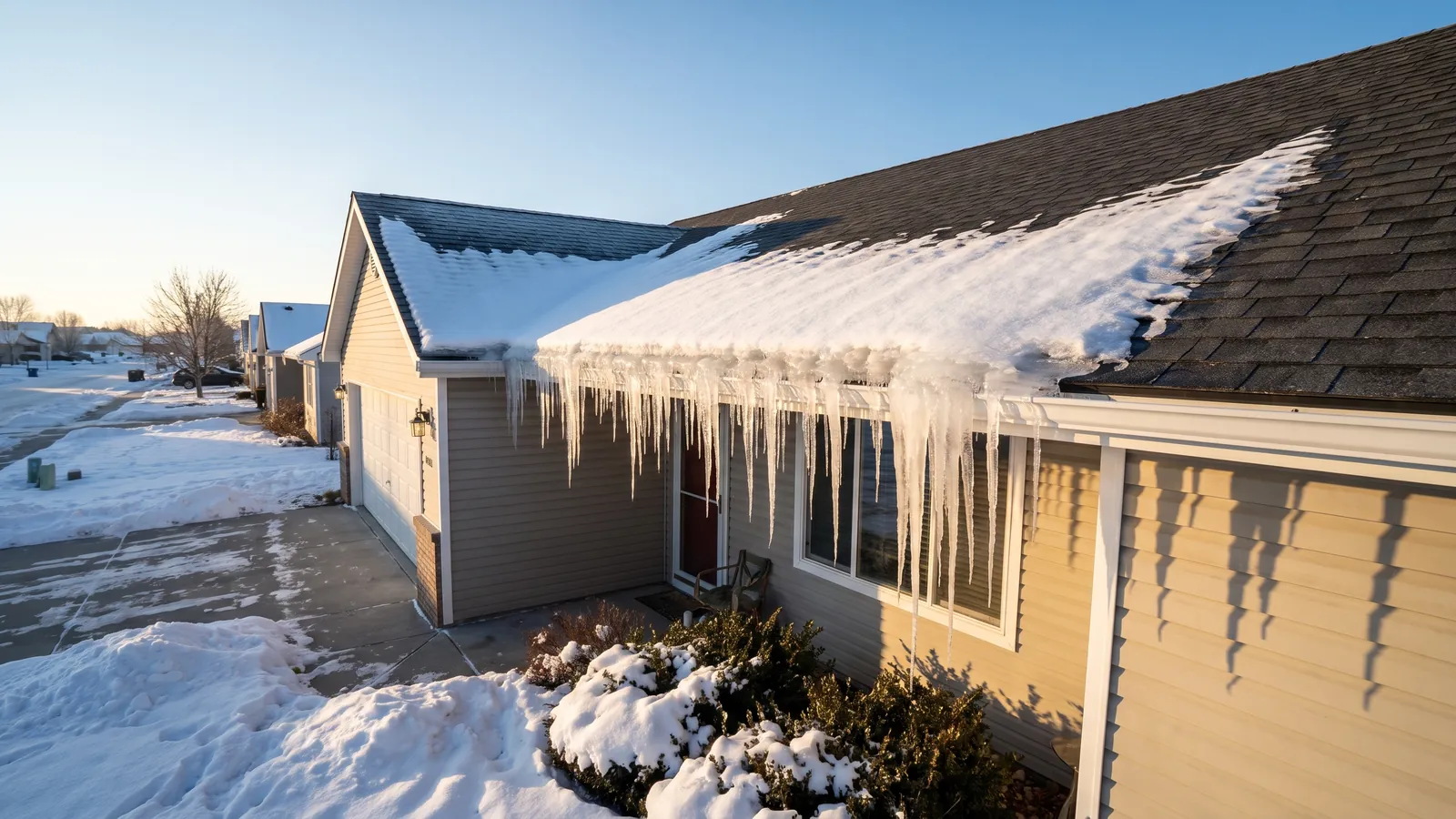
Heat from the house gets into the attic — through recessed lights, the attic hatch, bathroom fans venting into the attic, and thin insulation — and warms the underside of the roof deck. The bottom of the snowpack melts, the meltwater runs down the roof under the snow, and when it reaches the eave, which hangs past the heated wall and stays at outdoor temperature, it freezes. The ice builds into a dam. The meltwater behind it pools, rises above the top of the shingle course, and runs under the shingles onto the deck. Without an ice-and-water membrane on the deck, it's in the house. Meridian's design criteria say "roof ice barriers are not required," so most builders skipped it, and that's why the leak shows up on the north side of so many Paramount and Bear Creek houses every February.
The three-part fix
- Ventilation. Continuous soffit intake with baffles and a continuous ridge vent, balanced, with the box and gable vents removed. A properly vented attic stays close to outdoor temperature, so the deck stays cold and the snow stays snow. See attic ventilation.
- Air sealing and insulation. Seal the can lights, the hatch and the top plates; duct every fan outside; bring the insulation up to the R-49 that Meridian's 2018 energy code calls for in climate zone 5B. Heat that never reaches the attic can't melt anything.
- Ice barrier. Self-adhered ice-and-water membrane from the eave to at least 24 inches inside the exterior wall line, and in every valley. It's cheap, it goes on with every roof we replace, and it's the difference between an ice dam being a nuisance and being a claim.
What to do this winter
Before a rain-on-snow forecast, have the bottom six feet of the roof raked — that's where the dam forms and where the weight matters. If a dam has formed and water is coming in, call for steam removal; don't chip it, salt it or pressure-wash it. Watch for sagging ceilings, doors that suddenly stick and cracking sounds, which mean the load is past the limit — rare on a pitched house, common on a flat shop or carport. Keep the heat on if you travel; most policies exclude freeze damage in an unheated house. And in the spring, when the roof is dry, fix the cause so next January is boring.
Common questions
Does insurance cover ice-dam damage?
The interior water damage usually is covered, as sudden and accidental. Removing the dam and fixing the ventilation usually isn't. Keep the receipts for the emergency work — it's mitigation, and mitigation is typically covered.
Do heat cables work?
They keep a drain path open on a short north eave or a shaded valley, and they cost money to run. They don't fix the cause. We install them as a last step on roofs where the geometry beats ventilation, not as a first step.
Should I clear all the snow off my roof?
No — walking a snowy roof is dangerous and scraping it damages shingles. Rake the bottom six feet from the ground with a roof rake before a rain-on-snow event, and leave the rest.
Can a pitched house roof collapse?
It's very rare on the valley floor; the 2017 failures were flat and low-slope roofs where water ponded. A house roof that sags visibly under snow is a structural problem that existed before the snow, and it needs an engineer, not a roofer.
Related: Ice dams & snow removal · Attic ventilation · Roof replacement · Emergency roof repair